
Last year on our relocation cruise to Europe we met a lovely couple, Jackie and David, who divide their time between England and New Zealand. So taking our trusty little Hyundai i30 hire car on its furthest trip to date, we said our goodbyes to the girls and the dogs in Stapleford and set forth for The South.
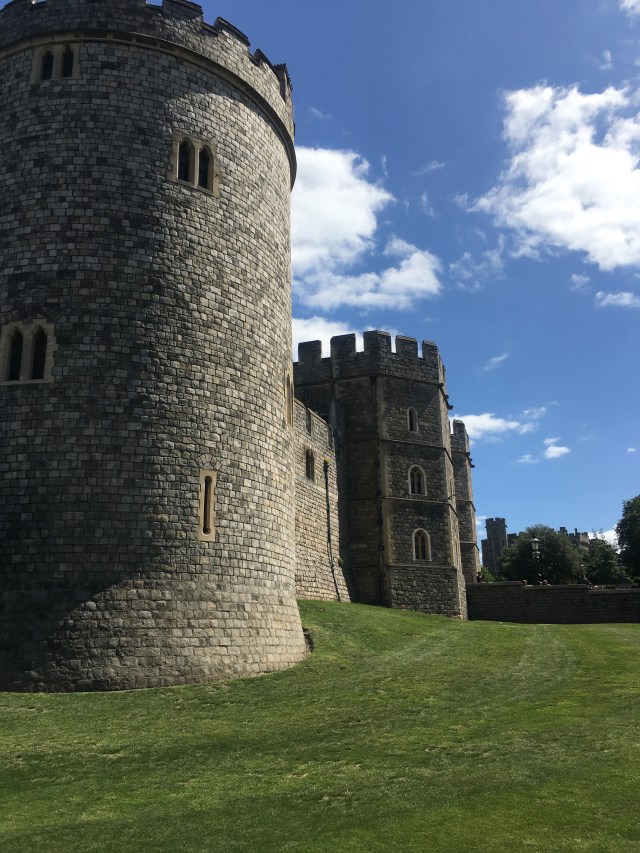
Our friends in Berkshire were generous and gracious hosts, making us very welcome in their comfy home in Little Sandhurst. We walked through the forest bordering their house and on the following morning drove to Windsor, the historic royal town where we saw the changing of the guard outside Windsor Castle and soaked up the atmosphere of this medieval town. Berkshire, where Graham spent seven years of his childhood, is one of the Home Counties. The corner of the county where we stayed is a most liveable part of England’s green and pleasant land and has become yet another of the many possible holiday home destinations that grace the Clapmacks’ Lotto dreams.
From Berkshire we retraced our steps of the previous year, taking the A303 past Stonehenge on the Salisbury Plain and on south through Somerset and Dorset to the East Devon village of Uplyme. We have both fallen in love with the South Coast of England from past trips and decided, for a retirement treat, to park ourselves there for a month of serious relaxation punctuated by walks on the Coastal Path. We returned to the Air BnB apartment we used last year, a cute, cosy studio in the leafy garden of our hosts Steve and Julie. It felt like a homecoming when we arrived.

So we settled in to a slow, gentle pace of life in the stunning location of Uplyme, right on the border of Devon and Dorset on the Jurassic Coast and a 30-minute countryside walk along the River Lim to the bustling little seaside resort town of Lyme Regis. Heaven.
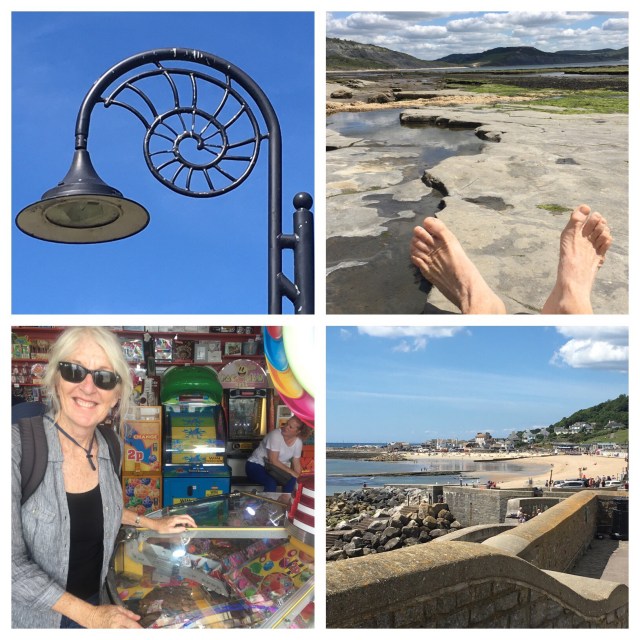
The closest village to the east of Lyme Regis is Charmouth, home to the Heritage Coast Centre, showcasing the region’s concentration of fossil reserves and also home to Graham’s Uncle Roy and Auntie Kay. We walked along the beach to Charmouth, stopping in for a cup of tea and a chat, then took the Coastal Diversion Path back to Uplyme.
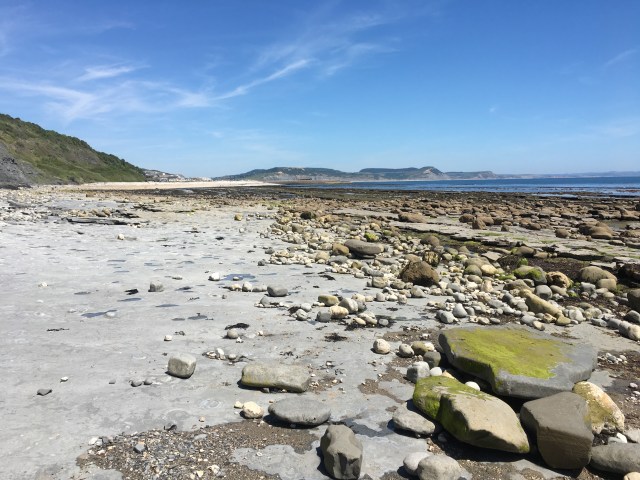
Just a little clarification here to complete an otherwise idyllic picture. We say we walked along the beach to Charmouth, but this consisted predominantly of pebbles, stones, rocks and boulders. Sue asked the salient question, “What do the Brits mean by ‘beach’?” causing Graham to reply, “Wherever the land meets the sea” (with the exception of coastal cliffs, naturally). That clears that up.
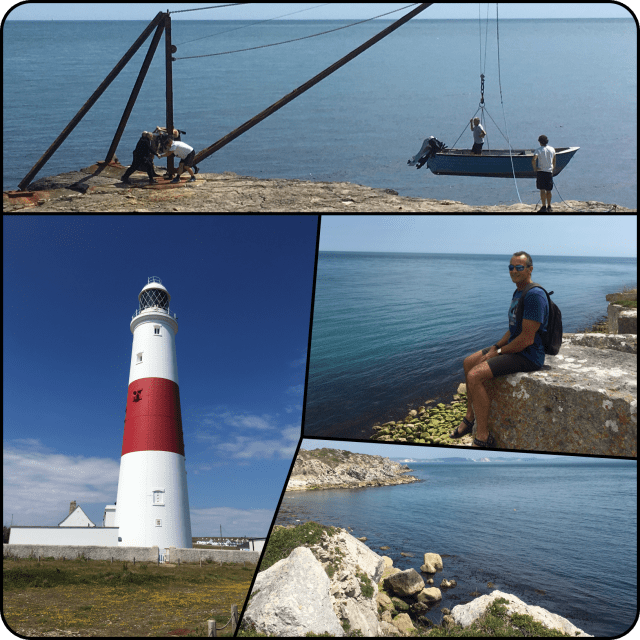
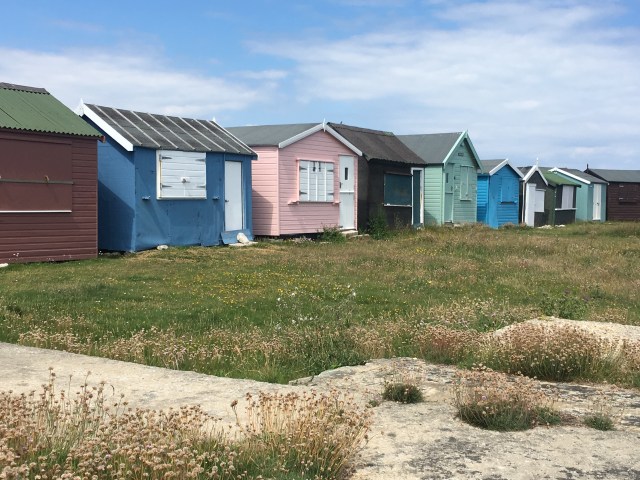
Continuing our assault on the South Coastal Path, we drove east towards Weymouth, a major holiday town, then onto the promontory of Portland (the Isle of Portland) where the famous limestone Portland Stone is still quarried. We completed a circular walk from Church Ope Cove on the Eastern side of the promontory, rounding the tip at Portland Bill. Stunning rocky cliffs and panoramic ocean views followed our progress. The clifftops at Portland Bill are dotted with lawnsheds, an eclectic if somewhat ramshackle collection of tiny holiday huts. Similar to the rows of colourful seaside huts that grace so many of England’s holiday beachfronts, the lawnsheds have no amenities and vary in size, building material and decoration. Perched on the clifftops with no seafront access, this doesn’t stop holidaymakers from setting up theirs deckchairs, brewing up on a Primus stove and having their hours in the sun. With the sheds resembling some of the makeshift homes we saw in South America, Portland Bill looks like some kind of holiday favela. (But the scenery is nevertheless quite breathtaking.)
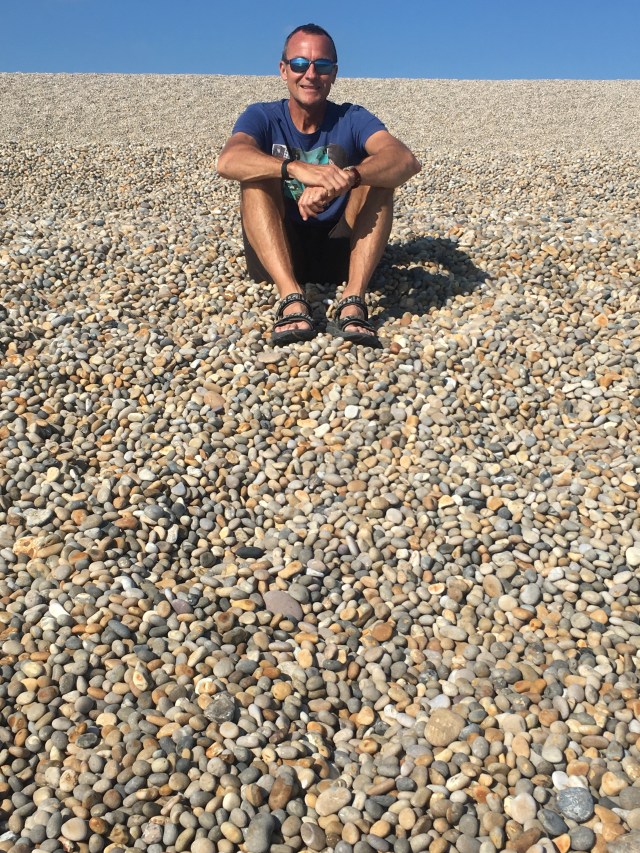
On the drive back, we stopped briefly at Chesil Beach, made famous in our minds by Ian McEwan in his novel of painful young love, “On Chesil Beach”. As if to emphasise the previous point about English beaches, Chesil Beach is an 18-mile long storm beach consisting of billions of pebbles washed up over 10,000 years ago, enclosing Fleet Lagoon, England’s biggest saline lagoon. There is now one pebble less since Sue’s visit. You can’t swim off the length of the beach due to dangerous drop-offs and strong undertows and you can’t walk or sit comfortably due to the pebbles. There is no vegetation and the banks of the pebble spit slope steeply in places and you have to pay to park your car. But apart from that, it’s lovely!
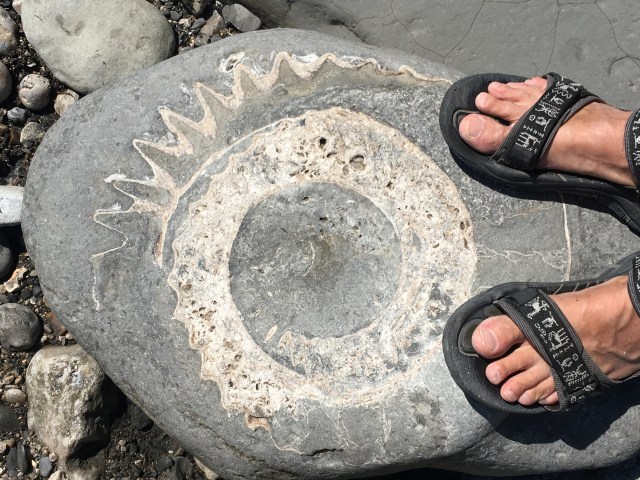
The East Devon and Dorset coastlines are famous for their fossils and consequently referred to as The Jurassic Coast. On a warm sunny day we walked again into Lyme to visit Graham’s cousin Wendy in her attic flat on a hill overlooking The Cobb (old stone pier) and the entire panorama of Lyme Bay – spectacular! Wendy took us on a beach walk across an expanse of rocks and pebbles to a flat bed of smooth undulating rock containing thousands of ammonite fossil remains. Known as The Ammonite Graveyard, this quiet patch of beach under a shale like cliff-face is breathtaking. You are literally walking on fossils as you wend a path through the rocks and over the flat section of ancient rock. How could such a primitive life-form organise itself so efficiently to establish a community burial ground?, Graham wondered as the sun beat down on his addled brain.
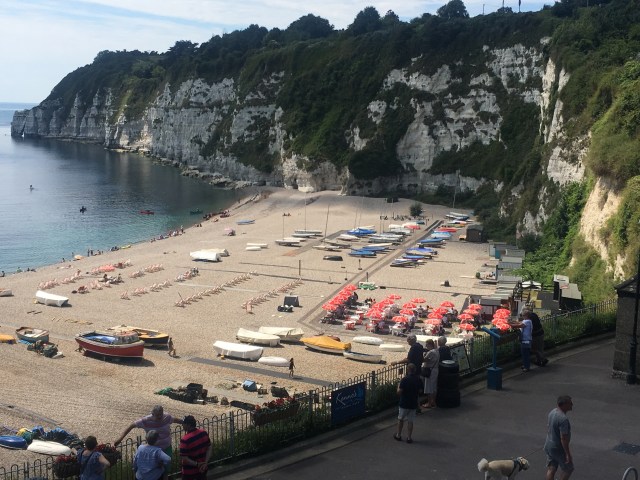
Summer by the seaside in England with beautiful weather ie it wasn’t raining. So the intrepid Clapmacks did what thousands of English holidaymakers do – they spent an afternoon on the beach. Rejecting the crazy-busy and rather cramped beach at Lyme Regis, we headed to nearby Seaton which has a much longer promenade and seafront. Armed with our Tesco beach towels and garbed in appropriately Aussie beach wear, we ventured onto the pebbles to secure our spot. Fortunately, the pebbles on Seaton Beach are all well rounded from centuries of tumbling about in the waves and this makes them quite bearable once a body is carefully positioned and kept relatively still. And so we whiled away a pleasant afternoon to the plaintive cries of gulls, the gentle chatter of children playing in the shallows, the smell of fish & chips frying, and the flap of deckchairs and windbreaks in the breeze, all overlooked by rows of coloured beach huts and a backdrop of limestone cliffs.
Mental note: next time, replace sunscreen with antiseptic cream to treat gravel rash.
 Clapmacks Foray into Retirement